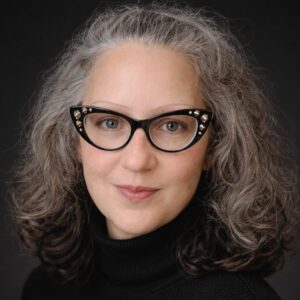
Ending Period Poverty in New Mexico
By Samantha Anne Carrillo
In the U.S., an estimated two in five menstruators report having struggled to afford period products. Neither Medicaid nor WIC cover pads or tampons. Under federal law, period products are classified as nonessential, taxable goods. If you’ve ever had a period, you already know these goods are pretty essential.
In 2020, Laurie Merrill asked herself how COVID-era remote learning could impact students who got period products at school. Merrill reached out to Dr. Veronica Garcia, then superintendent of Santa Fe Public Schools, with an idea to ensure remote students could access these products. Merrill says Garcia loved the idea, so she assembled 300 period kits in her father’s garage, which were picked up by and delivered to students’ families alongside lunches.
Five years later, volunteer-supported nonprofit Free Flow NM, based in Santa Fe, distributes period products at no cost across more than 165 organizations in 18 counties and Pueblos. Having achieved the goal of distributing half a million products last year, Free Flow endeavors to dispense more than one million period products during 2026.
Period poverty, Merrill tells ¡Viva New Mexico, is not what many people imagine it to be.
A Working Class Problem
“It’s not just our students, not just those who are unemployed or unhoused,” Merrill said. “It is our working class.”
Eighteen U.S. states still tax the purchase of period products. New Mexico eliminated its tax on period products in 2023, but state-level tax relief doesn’t touch the federal classification problem. In a state that consistently ranks among the highest in the nation for poverty, national stats undercount what’s actually happening here. “The national numbers need to be adjusted because we have some of the highest rates of poverty and ALICE statistics in the nation,” Merrill said. “Our [state] numbers are higher.”
ALICE—an acronym for Asset Limited, Income Constrained, Employed—is a United Way framework and data dashboard that highlights households that earn above the poverty line but are one emergency away from a financial crisis. The ALICE framework puts a sharper point on something Merrill hears from the communities Free Flow serves. Students watch their parents work full-time and still struggle and internalize that.
“So many individuals think they’re failing,” Merrill said. “It really shows a picture of how it’s not about the individual. It’s about our society.”
A Network to Dismantle Barriers
Free Flow NM’s expansion from a single distribution program to a seven-pronged nonprofit—with an eighth program launching now—didn’t come from a model. It came from listening to people as well as data. “Every program was launched because of a conversation or a story that somebody shared,” Merrill said. “Just talking with people and going, okay, that’s a barrier—let’s see how we can reduce that barrier.”
Free Flow’s general distribution program remains essential: period kits, each containing 25 items—tampons, pads of varying absorbency, liners—go out to partner orgs and from there to their clients. Each kit also includes flyers for incontinence resources and free reusable period products. Reusable medical grade silicon menstrual cups can maintain structural integrity for up to a decade.

The Story of Period Pods
For people who are outside partner networks or need access at 2am, Free Flow created period pods. “Period pods are like little community libraries, except instead of grabbing a book, you grab a bag of period products,” Merrill said. “There are no forms to fill out. It’s completely anonymous and many are accessible 24 hours a day.” Thirteen active pods stretch between Albuquerque’s South Valley and Taos; four more are forthcoming. Each is decorated by an artist or community.
Autumn Dawn Gomez (Taos Pueblo, Comanche), is an artist and a full-spectrum doula who serves as art director at Three Sisters Collective. In collaboration with Tewa Women United’s A’gin Youth Council–a program that transitioned into Gender Justice–Gomez led Indigenous youth (ages 11-17) of all genders in conceptualizing and creating Period Pod art in Española.
“They had been learning about periods in preparation for the project. They wanted a garden, a place where things could grow. That brought up the concept of a garden of plant medicine. There’s lots of plants that can help your body if you have a uterus. And these are those plants,” said Gomez, who trained as a full-spectrum doula at Tewa Women United.
“At Tewa Women United, they train full-spectrum doulas to be in the community. A full-spectrum doula is a person who supports pregnancy, whatever the outcome. Whether it is a full-term birth, whether it’s a C-section, whether it’s grief and loss or abortion support for elective or health reasons,” said Gomez. “We learn about the whole spectrum [of pregnancy] and how to be supportive of everyone.”
Stocking Community Cupboards
Period cupboards, Free Flow NM’s newest distribution model, go even further. Rather than pre-assembled kits, cupboard sites stock individual product packages—tampons, heavy pads, regular pads, liners—and allow each person to choose what’s right for their body and their flow. One cupboard visit typically provides five to six months of supplies.
The cupboard model is deliberately embedded in spaces that have established community trust: Umoja ABQ, which serves immigrant and refugee populations; Growing Up New Mexico, whose staff brings postpartum supplies directly to homes; and Acoma Pueblo. “Communities already have so much in place and have a relationship with their community members,” Merrill said. “We do our very best to stay out as much as possible and just provide.”
Fighting Period Poverty
Free Flow’s educational programming—covering menstrual health, period poverty, and product use—is open to everyone, without qualification. “Our presentations are open to everybody—whether they’ve had a period, are having a period, or will never have a period,” she said. “We believe there is a place for everybody to show up.”
On the policy side, HB 134—passed in 2023, mandating period products in all New Mexico public and charter schools—offers a case study in what happens when a good law suffers from bad implementation. The bill was funded for the first year. Then it wasn’t. “The initial funding didn’t get earmarked,” Merrill said. “It just got put into the school’s general funding. … Most schools were completely unaware of being able to access these funds.”
Free Flow NM currently supports more than 30 schools. Its disposable-product programs remain regional, not statewide, in part because the org is absorbing work that HB 134 was meant to fund. Properly earmarked funding, Merrill said, would shift that responsibility and free up capacity. In the meantime, monetary donations—not product donations, which complicate bulk bagging—are what allow the work to scale.
Learn more about and support the work of Free Flow NM at freeflownm.com. Find the org on Facebook and Instagram.