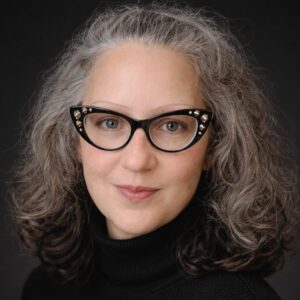
Lynnette Haozous Talks Decolonizing Mural Art
By Samantha Anne Carrillo
In the heart of downtown Albuquerque, a pigmented portal stretches across 505 Central Food Hall. Ancient trade routes are made visible in shades of ochre, turquoise, and verdigris. An Apache rider moves alongside a lowrider, Navajo rug patterns are interwoven with Pueblo pottery designs—all of it underscoring the fact that Route 66 was a homeland long before it was a highway.
The artist behind the “Cultural Crosswords” mural, Lynnette Haozous (Chiricahua Apache, Diné, Taos Pueblo), arrived at muralism through activism and a social work degree she symbolically handed to her family the day she decided to become an artist instead.
“Art is for everybody,” Haozous tells Viva New Mexico. “I do it for my community and to bring people together.”
A Portal on Route 66
Commissioned by the City of Albuquerque Department of Art & Culture for the Route 66 Centennial Celebration, Haozous’ Route 66 Remixed mural application was one she felt compelled to submit. “It is a responsibility,” she says. “You better apply for these things—to make sure our voices and representation are accounted for in these 100 years.”
The mural moves through time as well as space—carrying ancestral Pueblo landscapes, Navajo rug patterns, Chicanx lowrider culture, and an Apache rider on horseback—through a continuous portal.” These have been trade routes before it was even a road,” Haozous says. “Natives have contributed a lot to it, and I wanted that representation to be there.”

Decolonizing the Wall
Haozous earned a bachelor’s degree in social work at New Mexico Highlands University in 2016, driven by her work as an activist fighting copper mining on sacred Apache lands. She graduated, handed her family that sheepskin, and fully committed to life as an artist but her education also serves that work.”
“I take a lot of social work philosophies and bring them into my artwork,” she says. According to Haozous, you don’t just go into a community—you need to be invited.” A lot of muralism is about claiming the wall, putting your name on a space,” she says. “That’s a very colonial mindset—about conquering and claiming.”
Her process for creating public art inverts that colonial logic. “Muralism isn’t about me going to New York and putting Lynnette Haozous on the wall,” she says” It’s about going into a community, working with the people who are already doing the work, and being invited in—not just barging in.”
Community members, Haozous notes, already hold the knowledge that makes a mural matter: “They have the idea of what should be put on the wall—the message that’s going to speak directly to the community and impact them.”
She is equally candid about pressures that cut against this. “Quality work takes time,” Haozous says. “Establishing meaningful connections in community takes time. And the client [often] doesn’t have time—they have money.” When a client tries to compress that process, the decision falls squarely on the artist: “It’s on you—whether you move forward or step away.”
A 100% Community Mural
Haozous’ 2022 “Taos Matriarch” mural is an example she often returns to. Commissioned for the 100 Taos County Initiative, it took a year and a half from first conversation to last brushstroke, winding through a historic preservation committee—including a denial and subsequent reapplication—and collaboration with local youth, Pueblo representatives, and city and county officials.
“I can truly say it was 100% community,” she says. The resulting 150 feet of mural, stretching up to 10 feet high, was painted over 11 days with community members beside her at the wall. “That’s one I’m really proud of,” she says.
Mentorship in Community
Haozous names two people who shaped her practice. Artist Douglas Miles (White Mountain Apache, San Carlos Apache, Akimel O’odham) was the first to push her toward mural work and navigating the art world without losing herself in it: “Remaining true to yourself and your values, but somehow navigating all these institutions and grants.”
The second was Nanibah Chacon (Diné, Chicana), whom Haozous apprenticed with for a year starting in summer 2020, through a fellowship Chacon received through the Native Arts + Cultures Foundation. “It was really comforting to have someone thinking the same things I was,” she says. “There are few and far of us [Native women muralists] between.”
The experience moved her towards mentorship goals of her own. “There’s no sense in holding all this great knowledge to yourself and dying with it,” she says. “Just like culture—you want to keep it going, so you keep teaching our ways of life.”
Haozous has taught youth arts education at OffCenter Arts and Working Classroom and is working toward eventually taking on an apprentice of her own.
Claiming the Name
Haozous grew up moving—Phoenix to San Carlos to Taos Pueblo to the Four Corners, back to Albuquerque, where she has lived and worked for the last 15 years. The surname she signs on every mural has its own history.
Her great-granduncle, a celebrated sculptor known as Alan Houser, was born Haozous—a name he anglicized to gain purchase in an art world not yet willing to pronounce Indigenous names. “He was one of the first Native American artists to really be profound and out there,” she says, “and so he did have to anglicize his name to be more accepted in the new art world we were stepping into at the time.”
One of Haozous’ earliest encounters with the power of art was looking up at one of Houser’s bronze sculptures in downtown Phoenix—an Apache family that appeared to be cast at the scale of the surrounding buildings.”
“From my point of view, it looked like these Apache people were as big as those institutions,” she says.
Haozous returns to that image again and again—what it meant to see her people at that scale, and what it meant that the image needed to be created at all. Now, she says, the family is taking the name back. “When I put my last name—Haozous—on the wall, it’s a reclamation,” she says. “It’s saying: we’re still here.”
A Digital Frontier
Haozous recently expanded into digital illustration, teaching herself on an iPad using YouTube tutorials. A poster commission from the National Institute of Flamenco for the 39th Festival Flamenco Alburquerque followed—a dancer reimagined as a desert cactus woman, her skirts made of the landscape itself—and then a book cover for HarperCollins, illustrating Diné author Brian Lee Young’s forthcoming young adult novel “Shards of Silence,” which addresses intergenerational boarding school trauma.
With Truth and Reconciliation being a theme that’s coming up,” she says,” I thought this novel was something important to lend my art to.”
Learn more about Haozous and her art at lynnettehaozous.com. Follow the artist on Facebook or Instagram.