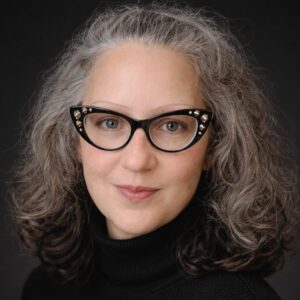
Sammie Chinigo Makes Chronic Illness Visible Via Art
by Samantha Anne Carrillo
Nearly 15 years of “but you don’t look sick” is a lot to process. Drawing on her multidisciplinary creative practice and experience living with an autoimmune disorder, Sammie Chinigo endeavored to uncover the unseen struggles of living with chronic illness by translating that experience into art and sharing it with her community.
The University of New Mexico art student opens her honors thesis show, Burden of Proof, at 6th Street Studio on Oct. 10.
Chinigo, formerly a hair, makeup, and visual effects artist working in the local film industry, said her included artwork centers on what people living with chronic illness rarely reveal to others.
“For almost 15 years now, I’ve [lived with] a chronic illness that has caused a lot of pain, a lot of isolation,” said Chinigo, in this interview with ¡Viva New Mexico!
Smile as Costume
The show’s seed was planted with a UNM class project requiring a persona. Chinigo said she photographed herself as a 1950s housewife draped in medical equipment, forcing a smile.
“That was my persona for so many years dealing with my chronic illness: pretending you’re not sick because no one believes you because they can’t see it,” she said. “This is my way of taking the mask off and showing people and hopefully resonating with people who have these illnesses as well and can [also] feel seen.”
A tapestry, “Unsolicited Advice,” strings together remarks, many with positive intentions and all with negative impacts, that she has collected. “‘Oh, you don’t look sick.’ ‘Oh, have you tried this? It worked for me,’” Chinigo said. “It’s all these things that are unrelated to actually helping someone mentally.”
“Very few of us are running around with bandages and open wounds. A lot of them are under our clothes,” she said. “We hide them on purpose, one to avoid questions, but also there is a weird scrutiny of people being sick.”
When working on local film sets, Chinigo said the pressure was even more intense. “You couldn’t be sick. There were no sick days allowed because someone would replace you.”

Soft Materials, Sharp Edges
Chinigo works across photography, sculpture, and textiles, and calls herself “a collector of techniques.” For a piece about scar tissue, she built a loom and taught herself to weave. “I can’t do math for anything, but I can look at something and build it,” she said.
“What most people see is that scar,” Chinigo said. “Underneath it is a bramble of tissue and interwebbings.” “I wanted to use softer fabric because you can fix scar tissue,” she said. “The key to fixing scar tissue is movement. And most people don’t realize that because no one tells you that.”
Fabric and china, she said, serve “to show that delicacy that we’re supposed to look like, but also the fact that it is sharp, it is rigid, and it can be repaired.”
Sitting With “Uncomfort”
Burden of Proof’s centerpiece is an assemblage built from a found couch, which Chinigo titled “Uncomfort.” Nails rise from its surface, and tree roots emerge from its base, soil ringing the work in its entirety.
“What people don’t realize is: those ‘comfort’ spaces are very uncomfortable when you’re sick,” she said. “There’s nothing more painful than laying on wounded bodies all day long.”
“I wanted to evoke the sense of smell with soil because that always makes me think of a funeral,” Chinigo said. “One thing that people don’t often talk about with chronic illness is that we think about death a lot. I wanted to have a piece that had people sit quietly with that.”
Decay, she said, mirrors her experience. “Even if you’re smiling on the outside, inside, I always felt like I was rotting.”
A Body of Survival
An older sculpture, “Beauty in the Breaking,” is a distorted torso that incorporates china, lace, and gold.
“I’m trying to find that beauty in how I am now and find that acceptance,” Chinigo said. “Even though it feels like I’m delicate, I am actually made of stone. Even with scars, they are hardened and make me stronger.”
She hopes visitors with similar experiences find a connection, and says producing the work helped her. “I was able to actually work out my own issues through making my own work,” she said.
Chinigo believes Burden of Proof can start conversations, both internal and communal. She hopes that her included work “might spark something inside them to recognize an emotion” and that she “can talk to people that are part of my community because I have a feeling they feel isolated as I do.”
Chinigo now looks toward the future. “I actually made it to 40 and that was the most joyous because I didn’t think I would make it there,” she said. “If I make it to 50, each decade is going to feel that much more powerful because I did it.”
Burden of Proof opens Saturday, Oct. 10, from 5-7pm, with a gallery walkthrough talk at 5:30pm, at 6th Street Studio (1029 6th St NW)